Journal
This page is going to be in reverse-chronological. These are all gonna be just random personal things I want to talk about, nothing serious and definitely not a daily project.
September 8, 2026 - Hello my chudlings
It has, in fact, never been more over. But also we're so back? Idk I'm the best to ever do it man.
I'm literally perfect. I'm so cool and smart and funny and sexy and talented I'm so awesome. If I was a woman I'd marry me ASAP bro I am the best. I'm on my megalomaniacal arc. Spelled that word right first try cuz I'm just that good.
I just wanna get fucked up and mosh but all my friends keep cancelling plans last minuteee BOOOOOOO. I deleted Taimi (fuck that app bro) and other dating apps are fiiiiine but I don't put any hope in them. Just a fun little thing to swipe on for 5 mins then move on. I'm over my ex, I don't really think about him unless I see something directly related to him then there's a little burn of pain (Harry DuBois moment). I'm still prob gonna just focus on friends until I finish welding school and move to Kenosha. Want to access MKE and CHI easily you know? Found out I can filter by race on Bumble which is a very funny feature, "I want to see native american girls only" insane. I wish I could filter by class I am tired of middle-class white girls who are all the same bro "I listen to $uicideboy$" "match my freak" BUDDY you have NO IDEA what you're asking for, I out-freak everyone without breaking a sweat. Can I filter out everyone who is happy?
Changelog for my lifeI deleted discord (nature is healing!) and I post a bit more on instagram now. It's a good motivator to get me to go out more, to have something worth posting! People say reels are addicting, so I just don't use them, simple as.
I started drinking which is fun, there goes my "I'll never drink!!" pledge I made when I was like 19. Also started smoking. I know I'll get addicted, but trvst the plan. I am exploiting the addiction for my own purposes.
Smoking is addictive, I'll crave cigarettes. So I only allow myself 1 cigarette a day, and I only let myself have one if two conditions are met: I am at a social place (a mall, a thrift store, a club, whatever), and I have struck up an actual conversation with at least one stranger. Only then can I have a cig. So I'm using nicotine addiction as a motivation for me to go out and meet new people. Brilliant!
I'll quit when I turn 30, that's my hard-limit. Also the low frequency of it means I won't spend a ton and won't get too bad of a cough. Also don't believe the fake news, smoking has hella aura, it looks sick. Objectively you look cooler when you have a cigarette. SMOKE AS MUCH AS YOU CAN!!!!!!!!!! IT CANNOT HURT YOU!!!!!!!!!!!!
I also limit myself to 4 YouTube videos a day, regardless of length. So what I watch is a lot more curated and worth it. If I only have 4 videos, I'm gonna watch only ones worth that time. And most times, nothing is worth that time, it's just pointless nonsense! So that's a good point already. There's also only a few YouTubers really worth watching in my opinion (Jonas Ceika, RoseMedia, and DJ Peach Cobbler) and the rest are eehhh.
I have been trying to exercise 3x a week, just minor stuff. It's not that I lack motivation, I just forget to do it. Oh well. Also I quit my stupid chud job so now I'm jobless and loaded with cash and just fucking around for fun.
I limit myself spending-wise. If I want something, like a bike or new clothes or whatever, I only let myself buy it on the last day of the month. Through the month I add or remove stuff from the list. It really helps control impulse spending. But other than that, I give myself a budget of about $150 a month, for buying stuff that can't wait. Merch for bands, good thrift-shop finds, whatever. My spending has gone way down already which is nice! Idk if it's being single or this new strategy but my spending is down 80%. It's probably moreso being single. Oh well, let me cope.
I dunno I'm just kinda moving along you know? Tell you what. NOBODY EVER READS THIS SHIT. Journals and blogs and shit nobody reads it. Keep it condensed to like 5 sentences maybe. QUIT BLOGGING.
I have a few project ideas I wanna work on. Simple, surface level type stuff.
- Luke Smith -- A thorough criticism of all of his writings. Break each one into a dropdown. An intro at the top. Could be a fun project.
- Anti-Reformist Aktion -- A point-by-point criticism of major 'leftist' programmes. CPUSA, DSA, PSL, RCI, RCP, ACP, ETC
- Civil Rights -- Analysis of afr. am., womens, gay rights movements. Radical movements turned into bourgeois ones, no real material effect.
- Monopolies -- Why they're good, why big business is good, why privacy is overrated.
Anyway that's about it, see ya!!
August 14, 2026 - Single again!
Very unfortunate. On the night of the 9th, at about midnight, I got a text from him, opening with an apology. Immediately I knew what was going to happen. I tried reassuring him that it's okay, I'm not upset. And at first I felt nothing. I guess I was still in shock, I didn't really know what to say. I touched on points but didn't actually go through with them. He told me he doesn't want to see me again, that he's been getting nightmares about the first time we met, that he's been dreading talking to me.
We had been planning to move in together in a couple years. We had been looking at apartments in north Chicago for us, he had even been trying to schedule tours. In December, we were going to take a week to go to Rocky Mountain National Park, I had a hotel booked for us. We had been planning on going out for dinner on Wednesday, to celebrate him finishing finals for his summer classes. Even earlier that day he was telling me how badly he wanted to show me this one game, because sometimes he'd call me and I'd watch him play a little indie story game.
We had all those plans, and then in an instant they were gone. I couldn't sleep until 2AM, then it was up at 6AM for work. I felt out of it. It felt surreal. Like it wasn't really happening. He was just there, he was just with me. Now there was nothing there. I would think about him every day, so often, and smile. I kept thinking about him, but instead I would have to try to not cry. Usually I'd have to step out during work a couple times to cry on the stairs down the side of the factory.
I wanted to beg him to come back to me but I knew it was pointless. He wasn't coming back. It wasn't because of who I am, it's because of who I was when we met, how we met. We were both so miserable and wanting to destroy ourselves. For me, the memory of that night was overall good. We met feeling miserable, but after a few hours we started to realize that we really, truly liked each other. That there was some sort of bigger connection. I had hoped that we could make something beautiful from that horrible night. But he couldn't move past it, he was stuck on it. I can't blame him, but it is sad. It's also sad that he never said anything, never sat down and talked to me about it. Just held it inside.
I didn't get to see him one more time. He's just gone. I didn't get to say goodbye properly. I never got to give him the gifts I was holding until his birthday. I wish he did it in person. That we could've broken up face to face rather than text. It doesn't feel right. If he had told me that we need to talk, I would've dropped everything to come down there.
When it happened, processing it, there were two sides of me. One side knew I need to let go, I need to move on, he's not coming back. There is nothing I can do to bring him back. There is no right thing I can say, right thing I can do. It's done. I need to just focus on me, get over it, make new friends and maybe meet someone else. The other part of me wants to never let go. To hold on to the memory of him and the love for him. To drink myself into oblivion so I don't have to think about the fact he's gone. Take whatever drugs I can get to just not lose him in my mind. Hoping I get in a car wreck, so I can die but die still loving him. See him one day in heaven, as angels. Or in hell. That part of me would not care if I went to hell, as long as it means being with him. It wants to stalk all the clubs in Chicago, hoping to find him, so I can beg him to please, don't leave, I'll give you anything. Every penny I have, every minute of my time, tear apart my body, dismember me, just don't leave me.
I know I need to listen to the first, but the second is so tempting. To be stuck in the past, of the good feelings that came with just sitting by him. But I can't do that. The past is never coming back.
So I never forget, there are two memories I want to write out.
The first was on my birthday I think. We had been to the art institute in Chicago, walked around for about five hours, looking at the paintings and sculptures and pieces. Explaining them to each other. Finding ones we liked. We eventually left to start driving away. I think it was back to his house. I remember it being a pain to get out of the parking garage, I remember him smoking in there. And as we drove out, it was raining. He had given me a CD, with a little drawing of himself, 20 songs he said changed his life. I had that playing nice and low as we drove through the rain. He held on to my arm as we drove, my hand was on his leg, and he fell asleep against my arm. I remember driving through the rain like that. Trying to not hit bumps, to not wake him up. That was one of the best moments of my life. I wished I could have a video of it somehow, to never forget it. I know that every time you remember something, you remember it less and less. The memory doesn't exist in solid-state. But I wish it did. I don't want to forget.
The second memory I'll just touch on key points. I picked him up from a party at about midnight. We went to a Circle K and bought him a diet coke, we went around back and we sat on the ground and he smoked. After a while he threw up on the pavement. A minute later he looked at it and asked if he threw up. Eventually I got him into the car to drive him home. Before we left the parking lot, he threw up on himself, on his clothes and on the car seat. I got him a plastic bag that was holding some old vinyls in the backseat, dumped them and just gave him the bag to throw up in. It was starting to rain, and I found a hotel nearby, knowing I couldn't drive him for an hour like this, on freeways, back to his Hindu/Muslim parents. So I found a hotel, we got there, and it was fully booked. I called maybe five different places, standing outside the car, while he kept throwing up. They were all booked. Eventually, I found one. We got there, we got a room. He tried to wash the vomit off of himself in the shower, then laid in bed. He kept making me promise to not have sex with him. While he lay, I tried to wash his clothes in the shower, get the vomit off of them. Then I went to bed with him. We slept together and it was perfect. The next morning, we had the best sex of my life, and I remember even the day of when we broke up he reminisced about how good it was. I could still taste the vomit when we kissed. Then we cleaned off in the shower and went to a laundromat so he could wash his clothes. He wore my underwear and my outershirt while we were waiting for the laundry machines. Then we took a train to downtown Chicago, I think it was an Amtrak to Union Station? From there we went to a water taxi to Chinatown. We walked around, talking, holding hands, we went through a plaza, we went and got food at a place. I remember he finished his entire plate of food, and I was happy to see that, because he's so skinny. It was some chicken dish, I think with Lo Mein. He tried crab rangoons for the first time and loved them. We went to some shop, walked down the main street of Chinatown, then took the metra red line back to union station, and then the amtrak back home. We got off a the wrong stop, and so while waiting for the next train, we got ice cream and he put a cigarette out on my chest. Walking past a restaurant, the outdoor seating packed, of nice upper-middle-class people, blowing smoke in front of him just to be a nuisance together, it was nice. Littering too. We talked to a random guy named John, who was a traveling carnival man who often rode the trains, he was nice. After he left, we talked. Because we knew his parents would be mad. He didn't come home when he said he would, and didn't go home in the morning because he knew they wouldn't let him to go Chinatown if he did, and we had been planning that. His parents were going to be incredibly mad. And when I dropped him off at home, they were. He told me that when he went inside, his mother told him to just pack his bags and leave. And he did, he packed, but he wasn't sure if he was going to stay or leave. He got the feeling that he should stay. After all, his mom overreacts often. I waited in my car outside for hours, ready to pick him up. In my mind, in that moment, I was ready to drop everything in my life, leave behind my job and family and everything, to be with him, even if we had to be poor and miserable, I was ready. He told me he was going to stay the night. Later, his dad told him he doesn't have to go, his mom was just being dramatic. But still, he wasn't allowed to stay overnight with anyone from that point on. So we never got to spend another night together. Instead, just days and small little dates. I think that is partially what killed the relationship as well. Not being able to sleep together in the same bed. Far more restrictive. Oh well.
Those are the two best memories I have of our relationship. The rest of it is filled with these beautiful little moments. Every time I would drive down there, when I would get near his house, I would just feel so happy, so at peace, like this is where I really belonged and where I was loved, this is where he was and where I was meant to be.
All of it is gone now. It's not okay. And that's okay. I don't know if I want him back. Obviously I do. But I don't think it would be good for me. I don't think I could go through another breakup. I would love to be his friend still, but seeing him may be too painful for now. I don't know.
August 9, 2026 - Centralization
For the longest time I wanted to focus on decentralization. Move away from Google, Amazon, whatever. Buy directly from manufacturers, buy from little brands, shop local, use private and small email clients, use local solutions for writing documents and spreadsheets, use a regional credit union, and so on. But honestly, why bother? What change does it make?
The inevitable tendency of business is centralization. The biggest firms outcompete and swallow up the smaller ones. This is how it works. To resist it is a bit silly. Competition always devolves into monopoly. And monopoly isn't bad. It's just the next step.
For instance, banking. I used a regional credit union. Sure, it's decent rates, good customer service, whatever. But Chase bank lets me do banking, investing, auto loans, credit cards, all in one service. It lets me get special deals and discounts, all in app. It has coverage in the entire country, ATMs everywhere. It is legitimately a better service, simply because it is larger. Or, for example, emails. Many sites don't even accept these smaller domains as valid emails. It's easier to use a Gmail account. It's more private? Okay? Who's reading my emails anyways. The government? Think they can't crack the encryption of some small third-party email client? Nonsense! And having a Gmail lets you use all sorts of other services -- youtube, drive, etc. Google drive is underrated. They can see your documents? Okay? You shouldn't be storing your social security number in a plaintext file anywhere, whether it's on a secure platform or not.
Also, it's nice not having to mess around trying to get a software to work, debugging it, whatever. Google gives you 15gb, which is plenty for the average person's needs in terms of writings, spreadsheets, etc. You just make a google account, and it works. Plus, the ability to share documents across one unified platform is great. You don't need to mess around with IP registries and making niche accounts for all services. It just works.
Also people complain nowadays about how there's nothing good on Netflix, that everything is broken up across a dozen streaming services. YEAH. Because people whined about a monopoly. But it turns out that having everything under one service is GOOD sometimes. Antimonopolists hate admitting that things legitimately were better when everything was all on Netflix.
Buying direct from manufacturer sucks, too. I bought a phone from Motorola. It cost the same as buying it on Amazon. It was shipped via UPS, and I had to be there to sign it. It took about five days to get here. When it finally did, I wasn't at the door. I couldn't pre-sign for it, the shipper (Motorola) required that I was there to sign for it. So what did they do, come back another day? No! Return to sender, back to Texas! I gave up and I bought it on Amazon. It was here in two days. Or a pair of boots. I spent a while looking for some nice boots. Decided to buy from a small business, in Poland. It was about the same price as boots on Amazon, but I thought hey they look nice, I'll get it from this place instead of Amazon or something. The boots came here via FedEx. It was $150 for the boots, plus $30 in shipping, plus $30 in tariffs. Quite a lot! And I ended up not really liking the look of the boots. What were my options? Well, I could return it. The cheapest option I found was shipping it back to Poland, for $90. I would only be reimbursed the cost of the boots. In other words, I would return the boots and still overall be down by $150. Versus Amazon, I return things all the time. They don't charge return shipping. They refund the cost of shipping. I walk into a Kohls with no box and just a QR code, show it to the guy, he takes it and I get my money back. Sometimes, like with a bottle of pills I had, I filled out a return for the item and they offered me a full refund and I keep the item. Or when I tried returning a different phone I got, for about $200, they offered me $35 to just keep the phone.
Sometimes these big services are just better. Amazon has a better return policy, quicker shipping, and same or lower prices than buying directly from the manufacturer. Everything being on Netflix makes watching movies so much easier. Having all your music on one app, as well. Imagine if every music label and podcast group had their own service you had to pay $1 a month to access, it would be infuriating. Google having services like Drive makes it incredibly easy to collaborate with others. Having a unified video platform, YouTube, is also extremely convenient.
Now imagine, like how MySpace or early FaceBook was, a unified social media platform. One where every single person has an account, because it's just the place to get an account. One central location, one tab where you can find your friends and see their posts, and a tab with a feed to see what random people are posting. You could find any of your friends on it, because everyone's on it. Would this not be better than having ten different platforms? I have seen so many people who have a separate twitter, bluesky, mastadon, reddit, instagram, facebook, whatsapp, snapchat, and so on. It's such a mess! And so many people are on one and not another, or maybe have no common platforms. If you meet someone at a club, you shouldn't have to struggle to find your common app to message on. You just had the social media app. This would legitimately be better than anything we have now. Centralization and monopolization is absolutely a good thing with the internet, when it comes to user experience, because it results in people having access to everything in one spot.
There is the obvious point about privacy. They can mine all of your data from this one spot. Okay? I don't care about datamining. What're they gonna do with it? Oh no, I'm being marketed to! Oh no, they're showing me ADS for products I might LIKE! The end is nigh! Use uBlock Origin like a normal person, problem solved. They sell all my data and can't use any of it for ads, looks like the marketing firms just got screwed over, great! Not my problem! Or the government, what, is gonna harvest my data to build a profile on me? Hate to say it man, but, uh, you shouldn't be posting about illegal activities on a public social media account. Like if you're posting "Can't wait to smoke crack" or "I'm gonna shoot my neighbor" or "I'm gonna blow up the county sheriffs office with my bomb", don't be surprised when the government knocks on the door.
Will this interrupt activism, online activism? Well, it won't reduce the effectiveness of it. Online campaigns like those one-day boycotts are already pathetically ineffective, and any mass demonstrations emerge autonomously and organically, rather than being some mass internet push. The ones like No Kings are, as well, extremely ineffective. You stand around for a day? COOL! TRUMP RESIGNED OVER THIS! You held up a sign calling him fat gay and retarded, I'm sure he's gonna be very sad when he personally reads that sign. These protests don't do anything, and they're already out in the open anyways. The actual movements at risk of government crackdown do not advertise themselves with public Facebook and Twitter pages anyways. Having a central social media platform would not be a bad thing. There's not really any downsides.
July 26, 2026 - Writing Articles
I'm trying to write an article. I have a bunch of articles where I think the core thesis is worth looking at and fleshing out, but the way I wrote my articles is terrible. Most of them are essentially written on the fly, in one sitting, with no sourcing or citation. They are extremely sloppy from any sort of authentic, academic standpoint. If I am writing polemicals or condemnations, sure that's fine. But if I'm trying to describe some social issue, going completely citation-less is bad practice. Occasionally I cite a passage from a Marxist text or the Bible, but never in any sort of strong manner. Other writers, such as Lenin and Bordiga, had plenty of statistics and data to inform their positions. Mine is a bunch of hearsay.
Besides being essentially unfounded and unqualified, they're presented in such an aggressively correct way, it's embarrassing. I have no credentials and only a cursory understanding. Moreover, I hardly ever present things in the manner of "this is a possibility" but rather "this is how it is". It is less investigative and more agitprop, and nobody is reading agitprop on neocities let's be real here. And I also start a piece with a totally incorrect mindset. I wanted to rewrite my AI and Labor article, I think I came off very vague and misinformed and so on. I go in with an idea, rather than investigating an issue. Instead of "Here is how AI will affect Labor", I should argue "How will AI affect Labor" which is a totally different manner of writing. Instead of coming up with a conclusion, finding data for my specific points, and then proclaiming it as truth, a more scientific approach is needed. Start with a broad topic. Find specific points to narrow in on. Find sources, find citations. Take notes on each source and article, put in the actual work. Then, flesh out those notes into a proper piece.
The piece I am most proud of is my COINTELPRO. While it does present an incorrect idea of a conscious conspiracy, it is well documented and sourced, from primary sources and documents. I had a list of the programs, and I had a whole chart about how they connected. I didn't just write it on the fly and research as I went along. I researched, then I wrote. I formed the idea properly in my head. The argumentation of it was founded on actual research and facts, not just vague notions with no citations.
For my rewrite, I also ran into an issue of evolving my writing as I went. For example, I wanted to see the number of layoffs over time, to show a pattern of tech layoffs. But the data didn't say much. Without a comparison to the total computer sector, it was pointless. So I brought up the BLS statistics, and found a bit more support for the idea there. But again, there was not much to actually extract from this. So I paralleled it with the AI spending, and found a correlation. But then I had to append the data again, because I felt it was important to also take a more specific look at the AI-heavy Silicon Valley firms, which may get lost in the data. In a broader macroeconomic sense it is irrelevant, but Silicon Valley tends to be ahead of trends, and so it could be a useful predictive region. So I started with an idea, and had to change my approach three times. Moreover, the mass-layoffs in tech didn't actually seem to be in any significant number, and many firms actually ballooned recently. This is the issue with going in with a preconceived notion, with trying to find evidence for claims. Often, these claims are simply incorrect. The easy route would be to simply pick data from other sources. But the more honest and the correct way is changing your approach to your work. If it gets taken seriously, it won't be easily blown over by light criticism or the actual statistics. If it isn't taken seriously, you at least have experience in then critically analyzing work. If you can critically analyze your own work, you can critically analyze the work of others.
Eventually I want to rewrite all of my articles, or cut out the ones I don't think are particularly important. But doing it properly isn't going to be an overnight project. Some of my articles were written on the same day as others, I wrote five articles on November 29th, and three of them were so bad I privated them. If I want to do them right, it's going to be actual research, actual scholarship, actual sources. That's another difficult part, finding real sources. Some sources are openly biased, which is fine if the bias can be identified and worked through. For example, an article by the West Virginia Coal Association, talking about 'Anti-Coal Extremists like Obama' and 'Non-Consensus "Global Warming"'. Obviously they can't be trusted politically or scientifically. But they were one of the only sources I found to state the number of West Virginians working in coal mines. Now, I was trying to show the decline of the coal industry. So the WVCA's bias would likely take that number and maybe inflate it slightly. Being able to identify biases is an extremely vital skill. There are no unbiased sources. The best sources are openly biased.
Other times sources can be totally made up. AI generated articles are sometimes easy to spot, other times they are quite hard. Sometimes the best bet is to go with your gut. I've found that whenever a site has an author and a "reviewed by", these people are not real. Other times, searching up the author can be helpful to see if they're a real person. Doing the AI and Labor rewrite has made me crawl through so many sites that I'm certain are AI generated which is quite fitting for the topic. I've found it best to just stick with the big-names (Deloitte, Stanford, Business Insider, etc.). For all their biases, they are at least credible, and many of their articles contain in-work citations that can be followed up on and investigated. It isn't bad to use small-name sources, layoffs.fyi as a good example, if it is demonstrably credible. Usually the bar for credibility is just if sources are cited. Other than this, the best place for information is government bureaus like the Bureau of Labor Statistics, FRED, or the Census Bureau, simply because they have the scale and history to provide useful sorts of statistics. Data aggregators like Statista and MacroTrends are far more suspect, but can be treated like Wikipedia in that they are a place to find sources to read yourself. But again, these can run into the issue of themselves cherry-picking isolated voices rather than other trends.
Overall, writing proper articles with proper research is hard. I haven't really done it since school. But I think I really will focus in on it, if I want to take myself seriously in terms of my writings.
July 25, 2026 - First Entry
Welcome to my first journal entry. We'll see how motivated I stay on this. There's a lot I want to talk about, stuff I'm excited about or want to get done. Ambition and all. I guess. There's a few big topics I want to talk about. For one, I want to cover the big one. Christian Communism. That's kind of my big master-work I want to make this site around. I want to connect the Marxian idea of a revolution, how it would realistically play out, and the apocalyptic literature like Daniel and Revelation. For example, the Millenial Reign of Christ and the Saints judging with Christ, connected to the Socialist transition-phase/low-phase communism and the Dictatorship of the Proletariat. Judgement day being the revolutionary terror. Armageddon being the death of reaction. Also the idea of the church essentially being recuperated by Constantine. The Roman state could not destroy the church forcefully, so instead it was absorbed, managed, and adulterated into being an instrument of class rule. Tracing the evolution and structure of the church paralleling the economic base of society (Feudalism and Catholicism, slave-economy and primitive Christianity, capitalism and Protestantism, and then possible Socialist and Communist church structures). Talking about authority, like the Bible says to obey authority, but it does not say what proper authorities are. Are all governments legitimate? What about in case of invasion or civil war? Who has true authority? Disobedience to save life is fine according to the story of Abigail and Nabal of Carmel. Then some more surface-level ideas, like linking the golden calf to the bull on wall street, 666 being linked to Solomon's 666 talents, the community of goods, etc. I do want to lean into the Marxian characterization of Capital and the money-capital circuit of reproduction as an abstract force, possessing those (businessmen and statesmen) to do its bidding, similar to demonic posseession with specific regard to Mammon.
I also want to write about the USSR and China, how they're not socialist etc. I am decently knowledgeable about the USSR, but with regard to China I know little. Only surface-level history and modern analysis. Still, it is enough to bring up commodity circuits, capital accumulation, and the clear Imperialism a la Lenin as embodied in the Belt-And-Road Initiative, China becoming a net exporter of capital and this leading to conflict with the USA especially over LatAm. Linking the current issues (Iran war, Ukraine, Cuba, Taiwan, Panama Canal, Maduro) etc to a broader political strategy of isolating Chinese allies. Maybe separating China and the USSR into separate articles would be good.
Also a look into the Origin of Family, Private Property, and State by Engels, I want to analyze any confirmation of the theory present in the Old Testament. Initially, I was reminded of it by the passage in OFPPS about Blood Avengers. Looking more into how Genesis-era family structures worked, and then Israelite structures, could be interesting.
Besides this, I'm doing well. It's about 10:20PM. I'm a bit tired! I did do quite a lot today. Got my weeks meals planned, got groceries, folded my laundry. Set up a 1x6x4 plank of wood as a shelf under the windowsill, got it with pocket screws. The middle screws felt loose, just spinning in place, didn't properly suck down. So maybe the studs aren't 16" spaced, but the stud finder said they were. Who knows! I do wanna put a potted plant on the shelf, add some life to the room. Maybe something aromatic. I also did a bit of cooking. Cut up part of a loin into chops, cut up a chicken, made some broth. Made brownies from scratch for the first time, I definitely undercooked them a little but oh well.
There's a few habits I wanna get into. I wanna read before bed, I recently got a little $70 ereader, electric ink, so that should be nice. Got Epubs loaded on there of most of my bookshelf. Thank you LibGen. I also wanna get M/W/F as my days for exercise. Either dumbbell stuff like shoulder press, curls, etc., or calisthenics like planks and pushups. Something to keep me a little fit. Then on those days do some skincare stuff, moisturize and exfoliate and so on. Now that I'm not single I gotta actually care about this stuff!
There's a few things I want to show off too! Such as this!
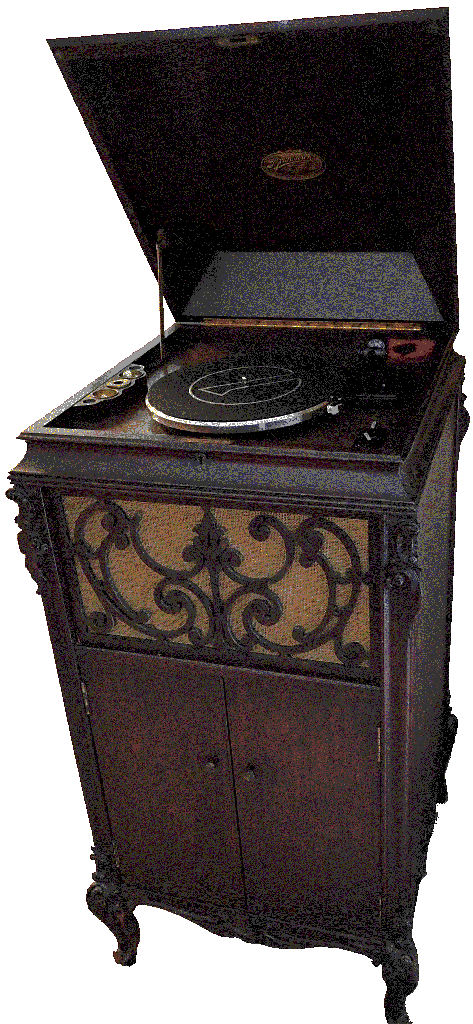 | I found an old record player at an estate shop, for about 100 dollars. It was a real beautiful one, made probably in the 1930s or 40s. It came with about a dozen shellac records, some from the 20s and some from the 40s according to Discogs. I reckon the guy bought the player, and some cheap 20s old shellac records, seeing how it was, before buying some new releases. That's my theory, putting it around the 1940s. It has no electricity, instead it was a hand-crank that would wind up the turntable, with a speed adjuster dial. The tonearm was one of those heavy metal ones, just a hollow tube going to the output. Turns out a towel was shoved in the horn behind that screen, so it must've been loud. I took out the internals and replaced it with modern technology (bought a record player on Amazon and stripped it for parts) as well as a sheet of stained and varnished plywood cut out for the modern turntable, so there isn't just an awful cutout. There were some troubles but I got it up and running well. The old components were beautifully put together, made with real velvet. I didn't throw it out. It'll be turned into a gramophone. But the record cabinet was so cool. The doors open to slots for albums to sit in, and there's a small panel for a placard to list what's in each numbered slot. I had to modify it to fit modern records instead of the old shellacs. Overall I probably spent $350 or so. I had to learn soldering and fiddle with 28awg wire crimps which was a total pain. But I guess that's the learning process! Overall it's cool, and the player I put in has bluetooth on it so I can play other music too. I do maybe want to upgrade the speakers, put in ones with bass that aren't just the ones wired to the circuit. Ones with more power, for when I use Bluetooth especially. That's about it for that, I'm just happy with how it turned out. |
Anyways I'm not sure what else I want to put in here. Maybe I'll end it here. I do wanna list my favorite novels so I'll do that real quick. Novels so no political stuff!
- The Stranger - Camus
- Notes from Underground - Dostoevsky
- Crime and Punishment - Dostoevsky
- The Road - McCarthy
- No Country for Old Men - McCarthy
- If This Isn't Nice, What Is? - Vonnegut
- Breakfast of Champions - Vonnegut
- Slaughterhouse Five - Vonnegut
- Brave New World - Huxley
- Johnny Got His Gun - Trumbo
Okay I'm out of ideas! I'd put a photo of me and of my boyfriend on here but I'm not sure if that's a good idea quite yet! Either way it's ten past eleven now. Goodnight!